((○))
Dr. Sarah Sapiens 11 March 2026
What Makes a Professional Reference Useful?
How to turn professional references from polite formalities into structured, predictive data that actually improves hiring decisions.
Read moreEvidence-based research and analysis from people science.
How to turn professional references from polite formalities into structured, predictive data that actually improves hiring decisions.
Read more
 Johnathen Evans-Guilbault 11 March 2026
 A structured reference check uses standardized questions and rating scales for every candidate, producing reliable data. Unstructured methods let references say whatever comes to mind.
Read more Johnathen Evans-Guilbault 11 March 2026
 Adverse impact occurs when a hiring practice results in significantly different selection rates for different demographic groups, regardless of intent.
Read more Johnathen Evans-Guilbault 11 March 2026
 Reference inflation is the tendency for references to be overwhelmingly positive, so positive they fail to distinguish between candidates. Structure counteracts it.
Read more Johnathen Evans-Guilbault 11 March 2026 Observer-rated personality is when someone who knows you rates your traits rather than you rating yourself. Research shows these ratings predict job performance twice as well as self-reports.
Read more Johnathen Evans-Guilbault 11 March 2026
 Inter-rater reliability is the degree to which independent raters give consistent assessments of the same person. It sets the ceiling for how valid any assessment can be.
Read more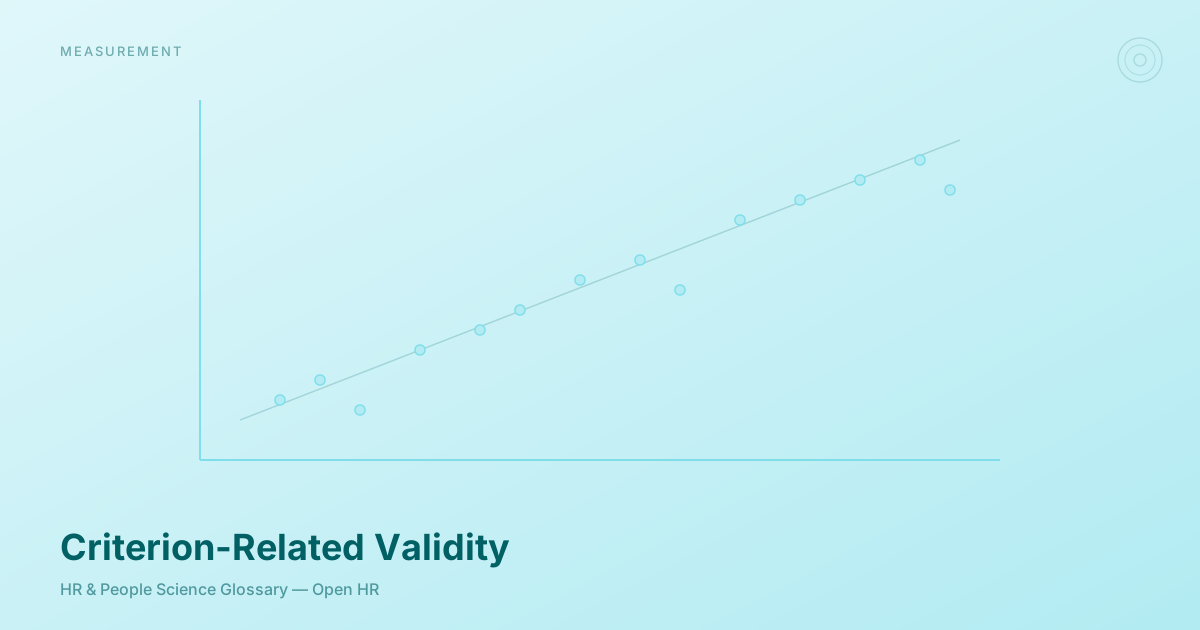 Johnathen Evans-Guilbault 11 March 2026
 Criterion-related validity is the degree to which scores on a selection tool actually predict a meaningful outcome such as job performance, measured by correlation.
Read moreTraditional reference checks are ubiquitous yet distrusted. We examine the five structural failures and the evidence-based alternatives.
Read more